
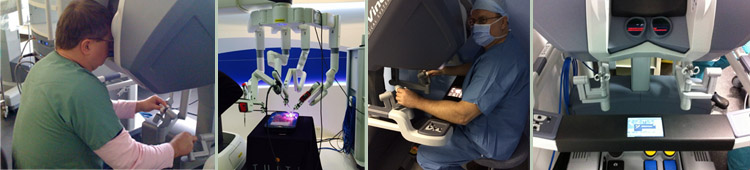
Technological development is always reflected in the improvement of surgery.
In laparoscopic surgery, which is also called minimally invasive surgery, the video camera and video technology in general are well-known and accepted procedures.
Nowadays, however, information science makes the use of robotics possible in surgery, furthermore, miniaturization will result in the creation of ever-smaller and more precise devices, with which surgery will be even more accurate and less invasive.
This mini-invasive technology aims to reduce the size of incisions and to search for and cure the diverse diseases through the natural body orifices.
Thus, the duration of the stay in hospital can be shortened, the post-surgical pain can be relieved, what is more, less blood loss and the lack of complications are also key advantages of this procedure. In addition, a quicker recovery from the operation is guaranteed.
Mini-invasive surgery treats pathologies either through the natural body orifices by using fibre optics or by applying the same method with miniature surgical devices through small incisions.
The different advantages of robotic-assisted laparoscopic surgery:
- special 3 dimension stereoscopic sight (2 optics paralell, 1080i)
- fix and stable operational vision
- precise and accurate incisions
- devices can rotate around 3 axles
- the surgeon works in a sitting position in absolute comfort
The first Da Vinci robot assisted laparascopic radical prostatectomy in the world was carried out in the CHU Henri Mondor University Clinic in Créteil (Paris, France) in 2000 and
in the same year the first live donor kidney was removed as well in CHU Nancy Brabois University Clinic (Nancy, France).
The most common pathologies that can be done with Da Vinchi telerobot surgery:
Urology:
- prostate cancer-radical prostatectomy
- pyelo-ureteral stricture operation
- gynaecological-urological prolapse, incontinence
- live donor organ removal
The method is more and more wide-spread among gynaecologists, abdominal surgeons, pediatric surgeons, ear, nose and throat specialists, head and neck surgeons, heart and vascular surgeons, neurosurgeons.
There are 1750 robots that are called Da Vinchi around the world, most of them are in the USA due to the manufacturer company, Intuitive Surgical.
To clear up misconceptions, it’s vital to mention that it is not the robot itself that does the operation, rather it is the surgeon.